A Spiritual Reflection on the Icon of Christ
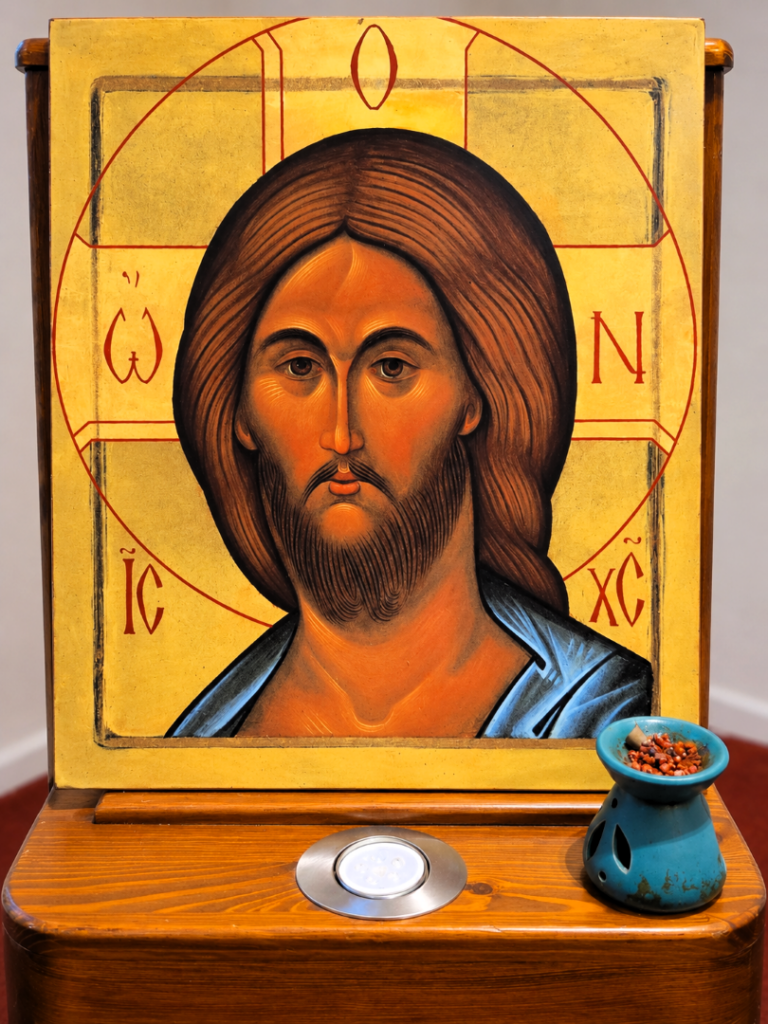
Look at Him, and allow Him to look at you.
When we stand before an icon, we are not simply looking at a religious painting. An icon invites us into relationship. It is a window toward the mystery it represents. We do not merely ask, “What do I see?” but also, “What is Christ saying to me?”
This icon presents Christ in a very direct and intimate way. He is not shown performing a miracle or surrounded by a dramatic scene. He simply faces us.
Perhaps that is the first invitation: to stop, become still, and allow ourselves to be seen by Christ.
The Face of Christ — “He looks at me”
The first thing that catches our attention is the face. Christ’s eyes are calm, serious and attentive. His gaze does not appear aggressive or condemning. He looks directly toward us.
There is something deeply personal about that gaze.
We often come to God with many words: our prayers, worries, failures, plans and requests. But perhaps prayer sometimes begins simply by allowing Christ to look at us.
Question for reflection:
If I truly believed that Jesus is looking at me with love right now, what would I want Him to see in me?
The Eyes — “You know me”
The eyes are particularly striking. They seem to invite us beyond the surface.
Jesus tells us:
“I know my own and my own know me.”
— John 10:14
Christ sees what others cannot see: our fears, our wounds, our hopes, our hidden struggles and also the goodness within us that perhaps we ourselves have forgotten.
Question for reflection:
What part of my life do I find difficult to allow Christ to see?
The Mouth — “What is He saying to me?”
The mouth is small and quiet. Christ is not depicted as shouting or arguing.
The icon almost seems to say: be quiet enough to listen.
We can spend much of our prayer talking to God. But Christian prayer also requires listening.
Question for reflection:
If I became completely silent before Christ, what do I think He might be saying to me today?
The Hair and Beard — “The humanity of Jesus”
The long hair and beard remind us that the One before us is not an abstract spiritual being. God became human.
Jesus had a human face. He experienced tiredness, friendship, rejection, joy, sorrow, pain and death.
The mystery of Christianity is not that God remained distant from humanity. God entered our human experience.
Question for reflection:
Where in my ordinary human life do I find it hardest to believe that Christ is present?
The Halo and the Cross — “Christ is more than a teacher”
Behind Christ’s head is the golden halo containing the cross. The cross-shaped halo is traditionally associated with Christ and points toward His identity.
The One looking at us is the crucified and risen Lord.
His glory cannot be separated from His self-giving love.
The halo reminds us that we are not simply looking at a wise man or inspiring teacher. We are being invited into the presence of the One who reveals God.
Question for reflection:
Do I relate to Jesus mainly as someone who helps me, or as the Lord to whom I entrust my whole life?
The Greek letters — IC XC
The letters around Christ identify Him as Jesus Christ — ΙC ΧC, an abbreviated Greek form of Iēsous Christos.
The icon therefore does not simply present an anonymous spiritual figure. It points toward a particular person:
Jesus Christ.
Faith is ultimately personal. Christianity is not simply following a philosophy or a collection of moral teachings. It is encountering Christ.
Question for reflection:
Who is Jesus Christ for me personally at this stage of my life?
The Golden Background — “The world of God”
The gold surrounding Christ is not simply decoration. In traditional iconography, gold can suggest the divine, heavenly reality.
There is no ordinary landscape behind Christ. He is presented against a reality that transcends our everyday world.
And yet He has entered our world.
This creates a beautiful tension:
He is beyond us — and yet He is close to us.
Question for reflection:
Where do I need to become more aware of God’s presence in the ordinary circumstances of my life?
The Red and Blue of His Clothing — “God enters our humanity”
Christ’s clothing contains deep reddish and blue tones. In traditional iconography, colours can carry theological meaning. The red can evoke humanity, earthly life and sacrificial love; the blue can suggest the mystery of the divine.
The combination can remind us of the central mystery of Christ:
true God and true man.
God does not save us by avoiding our humanity. He enters it.
Question for reflection:
Am I able to bring my whole humanity — my emotions, weaknesses, relationships and struggles — before God, or do I show Him only the “religious” part of myself?
The Symmetry — “Christ at the centre”
The composition is remarkably centred. Christ’s face is almost the axis around which everything else is arranged.
This can become a powerful image for our own lives.
Perhaps many things compete for the centre of our attention: work, family, money, possessions, relationships, worries, ambitions, even our problems.
The icon quietly asks:
Who is actually at the centre?
Question for reflection:
What is currently occupying the centre of my life, and is Christ really at the centre?
The Seriousness of Christ — “Love is not superficial”
Christ’s expression is peaceful but serious. There is no exaggerated smile.
His love is not sentimental. He knows the cost of love.
He knows the Cross.
And perhaps this is important for us. Following Christ does not mean that life will always be easy or pleasant. It means that even in suffering, we are not alone.
Question for reflection:
What difficulty am I carrying at the moment that I need to place into Christ’s hands?
Conclusion
Lord Jesus,
as I look upon You,
help me to remember that You are looking at me with love.
Give me the courage to open my heart to You,
to surrender what I carry,
and to trust You with what I cannot understand.
Stay with me, Lord,
and help me to keep You at the centre of my life.
Jesus, I trust in You.
Amen.
This reflection was used during our B’Kara Sta Maria GFN monthly meeting on 3 September 2026.
